The rain spatters
violently, ineffectually,
against the double-glazed windows;
we pull across the curtains
as the evening draws in,
place a few more sods of peat
on the flames of the growling,
crackling fire, then nurse
our drams of single malt.
The whiskey gleams golden
in the Waterford tumblers
as we listen to (yet half ignore)
the shrieks and whistles
of the wild Atlantic winds.
I don't know, says Uncle Liam,
how much of this you understand.
Upstairs
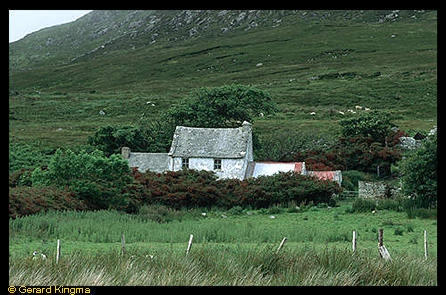
in this whitewashed cottage,
planted, perhaps perversely,
on the farthest edge
of nearly nowhere,
sits a four-poster bed
with sagging springs
in a large cold room
no longer used nor visited;
it is occupied now
by dust and sepia photographs,
but it was in this room
that long dead newlyweds
began the slow
inevitable genesis
of unresolved tragedy.
The lashing rain, the heartless winds,
deride our humanity;
now as in times past,
and in the coming times to be,
they mock our hopes,
our aspirations,
our nationality.
Turbulence, pain, famine, grief.
On the bedroom wall,
housed in an ancient frame,
is a faded stitching sampler:
"God Bless Our Happy Home",
piously, if uncertainly,
accomplished with her own hands
by Emily May MacCarthy
on October 20, 1843,
the fifth of eleven children
and one of the seven
who starved to death
along with her despairing parents.
In the photographs, dapper
gentlemen with large moustaches
stare into an unforgiving lens
with comical expressions
of puzzled defiance;
they stand in front of studio
backdrops, and very
tasteful potted palms.
James Boyle Roche. Photographer.
15 Bridge Street. Ennis
is stamped within an oval
in the corner: the address
still exists, I went to have a look,
it is now a fast-food restaurant.
Wedding couples,
equally unrelaxed, stare
across a canyon of years:
I could not even begin
to talk to these people.
He sits, she stands,
and she places a tentative
restraining hand
upon his rigid manly shoulder.
There is another
strangely out-of-place picture
of my great-uncle Marteen Rua,
the red-haired boy,
shot dead in the civil war;
a cocky 19-year-old
with a cheeky grin,
he is brandishing
an enormous revolver
and has a jaunty cigarette
jutting from his lips.
I can tell from the look of him
we could have had a drink,
we could have had a talk,
he cuts through
all the lace-curtain piety,
the respectability,
the fear: he looks
so devil-me-care, so modern.
But the rain will have none of it:
it comes down in buckets,
it comes down in cascades;
You will never, you will never
never never be free, it says:
in this country you will never
never be released from the past.
Liam is uncharacteristically
subdued; embarrassed, he shifts
from foot to foot in front
of the warm and blazing fire.
We are warmed outside,
and inside, perceptibly,
thanks to the single malt.
Upstairs
there are more old photographs
on the dresser and on the sideboards:
cloche hats on smiling elegant women,
charabancs, baggy suits on the gents,
who grin and squint in the harsh sunlight
of long forgotten days, some of them sporting
those ridiculously shortened neckties:
my unknown, unknowable ancestors.
A flicker of empathy,
of understanding,
slips through
this threnody of regret.
Listen, I think I'm going to bed,
it's been a really long day, I say.
Liam frowns. An awkward
silence ensues: Emmmm ...
Listen to me. There's something
I really need to tell you.
It's about the family ....
Don't.
It will keep for another hundred years.


No comments:
Post a Comment